Article V, U.S. Constitution
The United States Constitution is a beautiful thing! In our modern era, it is not without its shortcomings, however. Our federal government has had almost 250 years to diverge off the original design of the Constitution. When the Founders were drafting and reviewing the document, George Mason, delegate from Virginia (replacement for President George Washington), pointed out that only the federal government was authorized to make changes to the document. This has happened 27 times in our history. The first time was to propose and adopt the Bill of Rights.
EVERY other delegate to the Continental Congress realized that was a problem and without debate adopted the revised language that became Article V of the Constitution.
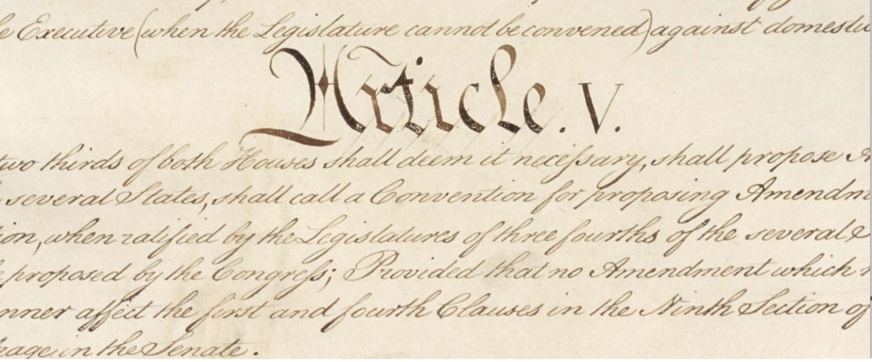
The Congress, whenever two thirds of both houses shall deem it necessary, shall propose amendments to this Constitution, or, on the application of the legislatures of two thirds of the several states, shall call a convention for proposing amendments, which, in either case, shall be valid to all intents and purposes, as part of this Constitution, when ratified by the legislatures of three fourths of the several states, or by conventions in three fourths thereof, as the one or the other mode of ratification may be proposed by the Congress; ...
- United States Constitution, Article V
So the federal amendment process has been followed, but the state side has not. According to Dr. Michael Farris, JD (Constitutional law professor), more than 450 applications have been submitted to hold one of these Constitutional amendment conventions, but not enough have been submitted on the same topic to require Congress to call the convention.
What's important to note with the Article is that the states are given the same authority and power as the federal government. They are not accountable to the federal government, the opposite is true actually...the federal government is accountable to the states! There is NOTHING the federal government can leagally do to stop or tharwt this process. They could attempt to pass amendments on their own, but that doesn't stop the state process. It might make it moot in the eyes of the state governments, but that is on them and part of our federalist governemental structure.